
Timeless Home Decor: 12 Ideas to Transform Any Space
Walking into a beautifully decorated home has a way of instantly lifting your mood. It’s not about spending a fortune or following every passing trend — it’s about creating a space that feels intentional, comfortable, and truly yours. Whether you’re settling into a first apartment, refreshing a family home, or just looking for a weekend project, these ideas will help you build a space you love coming home to.
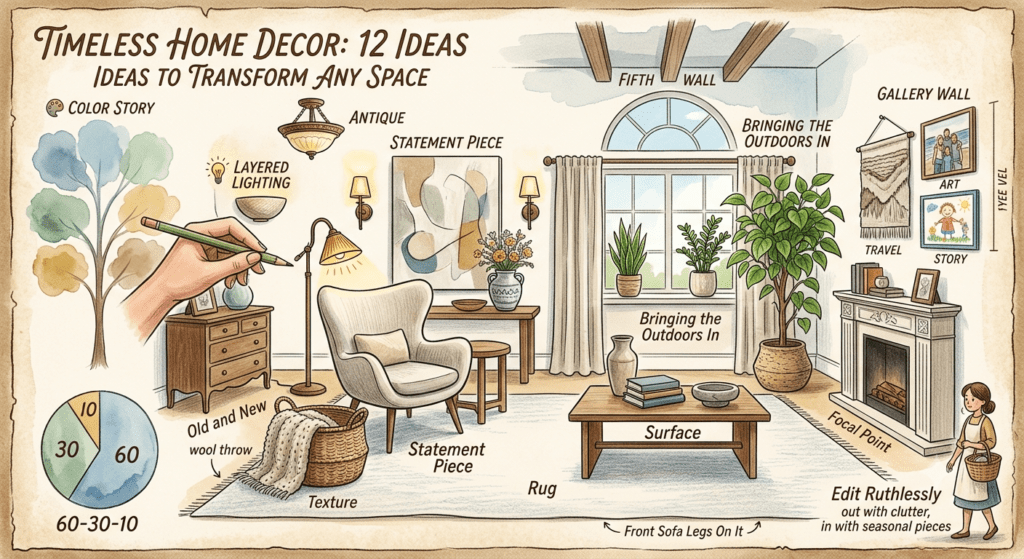
1. Start With a Color Story, Not a Color Scheme
Most people pick paint colors first and figure out the rest later. Flip that order. Start by deciding how you want a room to feel — calm and airy, warm and cozy, bold and energetic — and let that feeling guide your palette.
A simple trick used by many interior stylists is the 60-30-10 rule: 60% of the room in a dominant color (usually walls and large furniture), 30% in a secondary color (upholstery, rugs, curtains), and 10% in an accent color (pillows, art, small decor). This ratio keeps a room visually balanced without feeling flat or overdesigned.
2. Layer Your Lighting
Nothing ages a room faster than a single overhead light doing all the work. Professional designers typically layer three types of lighting in every room:
• Ambient lighting — the general light that fills a room (ceiling fixtures, recessed lights)
• Task lighting — focused light for specific activities (reading lamps, under-cabinet kitchen lights)
• Accent lighting — light that highlights a feature, like a piece of art or a bookshelf
When these three layers work together, a room feels dimensional and warm instead of flat and clinical. Even a small apartment can benefit hugely from adding one or two floor lamps and a couple of table lamps to a room that previously relied only on an overhead fixture.
3. Invest in a Few Statement Pieces
You don’t need every item in a room to be expensive, but one or two well-chosen statement pieces can elevate an entire space. This might be a sculptural chair, a large piece of original art, a striking light fixture, or a beautifully grained wood table. Surround your statement piece with simpler, more affordable items, and the whole room will read as curated rather than cluttered.
4. Let Texture Do the Heavy Lifting
If a room feels flat or boring despite having “the right” colors, texture is often the missing ingredient. Mixing materials — a nubby wool throw, a smooth ceramic vase, a woven jute rug, a soft linen curtain — creates visual interest even within a fairly neutral palette. This is especially useful in all-white or all-neutral rooms, where texture becomes the main source of character.
A good exercise: stand in your room and count how many different textures are visible. If the answer is two or fewer, look for opportunities to add a knit blanket, a rattan basket, a stone bowl, or a linen cushion cover.
5. Rugs Anchor a Room — So Size Them Correctly
One of the most common decorating mistakes is choosing a rug that’s too small. A tiny rug floating in the middle of a large room makes the whole space feel disjointed. As a general guideline:
• In a living room, aim for a rug large enough that at least the front legs of your sofa and chairs rest on it.
• In a dining room, the rug should extend far enough that chairs stay on the rug even when pulled out.
• In a bedroom, a rug that extends about 18–24 inches beyond the sides of the bed creates a grounded, intentional look.
Sizing up often feels like a splurge in the moment, but it makes the single biggest difference in how “finished” a room looks.
6. Bring the Outdoors In
Plants remain one of the most affordable and effective decor tools available. Beyond their visual appeal, greenery softens hard lines, adds color, and genuinely improves the feel of indoor air. If you’re new to plant care, start with resilient varieties like pothos, snake plants, or ZZ plants — all of which tolerate low light and occasional neglect. For a more dramatic effect, a single large floor plant in an empty corner can do more for a room than several small ones scattered around. Odd numbers (one, three, five) tend to look more natural than pairs.
7. Don’t Neglect the Ceiling
The “fifth wall” is one of the most overlooked surfaces in home decor. A coat of paint on the ceiling, exposed beams treated with a wash, or even a simple statement light fixture can transform a room’s proportions. Painting a ceiling a shade darker than the walls can make a room feel cozier and more enclosed — ideal for bedrooms and dens. Painting it a crisp white or a soft sky tone can make a low ceiling feel taller and airier.
8. Curate Your Surfaces
Every flat surface in a room — coffee tables, console tables, shelves, mantels — tells a story about how you live. The key to a styled-but-lived-in look is grouping objects in odd numbers with varying heights. A classic approach:
• One taller item (a vase, a stack of books, a small sculpture)
• One medium item (a smaller vase or a framed photo)
• One low, textural item (a bowl, a candle, a small plant)
Avoid lining objects up in a row; instead, cluster them with a bit of overlap so the grouping feels natural rather than staged.
9. Choose Art That Means Something
Art is one of the most personal elements of decor, and it doesn’t need to be expensive to make an impact. Consider framing a favorite travel photo, a child’s drawing, a piece of fabric or textile you love, or a print from an independent artist. Hanging art at eye level — generally about 57 to 60 inches from the floor to the center of the piece — creates a cohesive, gallery-like feel throughout your home.
For a gallery wall, lay pieces out on the floor first to test different arrangements before committing to nail holes. Mixing frame styles and sizes tends to look more collected and interesting than a perfectly matched set.
10. Balance Old and New
Rooms that mix eras and styles almost always feel more interesting than those filled with matching furniture sets. Pairing a vintage or secondhand piece — a thrifted armchair, an inherited dresser, a flea-market mirror — with more contemporary furniture creates depth and a sense that the room evolved over time rather than being purchased all at once from a single catalog.
This approach also happens to be budget-friendly and more sustainable, since it encourages repurposing and reduces the temptation to buy everything new.
11. Give Every Room a Focal Point
Walk into any room and your eye should be drawn somewhere specific — a fireplace, a large window with a view, an accent wall, or a striking piece of furniture. If a room doesn’t have a natural focal point, you can create one. Arrange seating to face a piece of art, add a bold headboard in a bedroom, or use a patterned wallpaper on a single wall to draw the eye. A defined focal point gives a room structure and makes furniture arrangement much more intuitive.
12. Edit Ruthlessly
Perhaps the most underrated decorating skill isn’t adding — it’s removing. Once a room is decorated, step back and ask whether every item is earning its place. Cluttered surfaces, mismatched knickknacks, and over-accessorized shelves can undo even the most thoughtfully chosen decor. A good habit is to do a seasonal edit: put away a few decorative items every few months and rotate in others you’ve been storing. This keeps a space feeling fresh without requiring new purchases.
Bringing It All Together Great home decor isn’t about following a rigid formula — it’s about paying attention to how a space makes you feel and adjusting until it feels right. Start small: layer in a new light source, size up a rug,