
History of the Elder care Industry
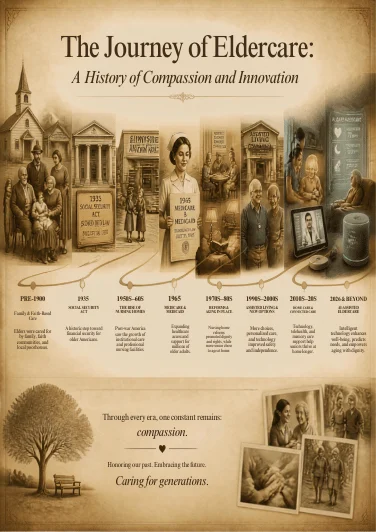
Elder care was a family responsibility, with those lacking family relying on churches and poorhouses. Industrialization broke up multigenerational households, pushing old-age poverty into public view and prompting early pension experiments.
The first major turning point. It guaranteed retirement income, enabling seniors to pay for care rather than depend solely on family. This spurred private boarding houses and rest homes.
Purpose built nursing homes emerged. 1965’s Medicare and Medicaid triggered explosive, profit-driven growth in long-term care, creating the modern industry with licensing and reimbursement systems.
Exposes of neglect sparked backlash, leading to the 1987 Nursing Home Reform Act and an “aging in place” movement spawning home health agencies, adult day care, hospice, and gerontology as a discipline.
Assisted living, continuing care retirement communities, geriatric medicine as a specialty, and early medical alert devices gave families more choice in how and where care happened.
Aging baby boomers, smart monitoring tech, memory care, and home care agency growth drove expansion, alongside private equity consolidation. Covid-19 exposed nursing home vulnerabilities, accelerating a shift toward home-based care and telehealth.
The global market is worth roughly $1.6 to 1.9 trillion, projected to reach $2.8 in between 3.7 trillion by the mid-2030s. Home care now dominates, AI aids monitoring and fall detection, caregiver shortages persist, consolidation continues, and countries worldwide are building or updating eldercare infrastructure and regulation.
Overall, the industry has moved from private family obligation to charity to a regulated medical-industrial sector, and now toward a tech-enabled market balancing autonomy, quality of life, and cost.